EU AI Act · Article 50 · n8n
The human is the gate.
The ledger cannot be edited.
An n8n module that turns Article 50 transparency duties into one approval step inside any production line: label, ask a person in Slack, write an append-only record, keep a registry of every AI system on the instance.
Why this exists
From 2 August 2026 the deployer, not the model vendor, answers for these.
Art. 50(4) §1 · deep fakes
Generated or manipulated image, audio or video that resembles a real person, place, object or event must be labelled. Artistic or satirical work: limited disclosure.
Art. 50(4) §2 · public-interest text
AI-generated text published to inform the public must be disclosed, unless a named person took editorial responsibility.
Art. 50(1) · chatbots
A system that talks to people must make its AI nature clear unless it is obvious.
Art. 50(3) · emotion & biometrics
People exposed to emotion recognition or biometric categorisation must be told.
Most automation lines wire a generator straight into a publish node. Nothing in between knows the law. That gap is what the kit fills.
Where it sits
One sub-workflow call inside any n8n line.
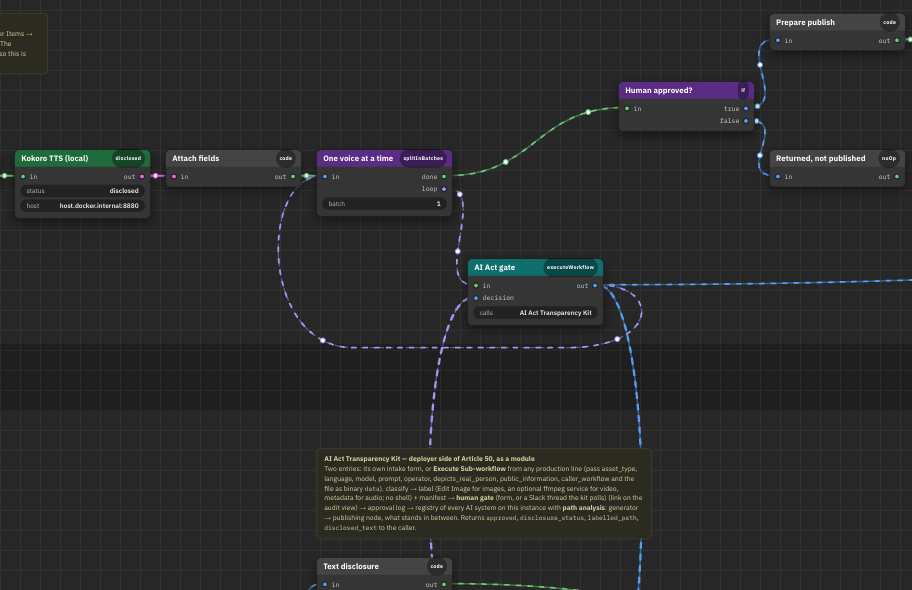
A real line: notice text → three local TTS voices → AI Act gate → publish only what a human approved. The map is generated from the running workflows, not drawn.
1
The line passes the asset, the model, the prompt and what it depicts.
2
The kit classifies under Article 50, burns the label in, stores a manifest.
3
A person decides in Slack. The kit returns approved, disclosure_status and the labelled file.
Intake → label
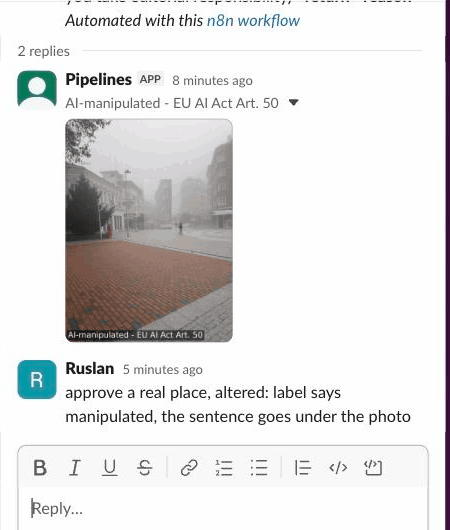
A real place, altered, is a deep fake. No person needed.
Original photo. Varna, fog.
A building added at the end of the street. AI-manipulated label burnt in, sentence goes under the photo.
Same alteration declared as satire. Disclosure limited to a corner label, as Art. 50(4) allows.
Art. 3(60) covers persons, objects, places and events. The classifier reads four intake answers: what it shows, generated or manipulated, artistic or not, consent reference.
The gate
A person decides in a Slack thread. The kit only listens.
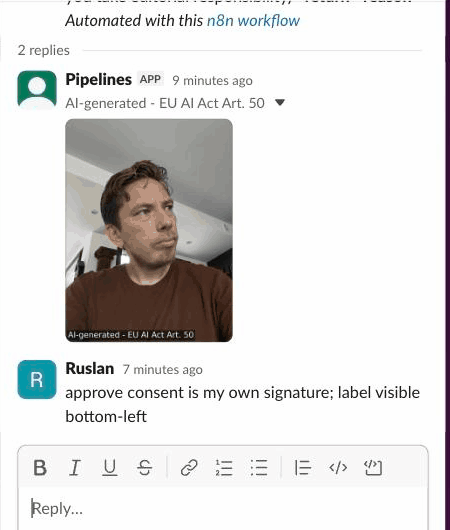
Post with the disclosure sentence and the labelled file → reply approve, editorial or return <reason>. Reviewer identity comes from Slack, not from a text field.
- Outbound polling only. n8n needs no public address, no inbound webhook.
- No answer in 24 h → the asset is returned automatically and logged as such.
- Swap Slack for a form, Teams or e-mail: the gate is one node group.
The record
Append-only ledger, hash-chained. Three real rows.
| Asset | Reviewer | Decision | Status | prev → hash |
|---|
text · gpt-4o
public notice | Ruslan
Slack U0C2N5PEJJV | approve · dates checked against the municipal order | disclosed | 84c55f81 → 92d911ce |
image · Photoshop GF
real place, manipulated | Ruslan
Slack U0C2N5PEJJV | approve · label says manipulated, sentence under the photo | disclosed | 5f9ee8ae → 84c55f81 |
image · Midjourney
real person, consent on file | Ruslan
Slack U0C2N5PEJJV | approve · consent is my own signature | disclosed | 54c702cf → 5f9ee8ae |
Postgres, two triggers.
BEFORE INSERT computes sha256 over the previous hash and the row. UPDATE and DELETE raise. verify_chain() walks the chain on every audit render.
What an auditor asks first.
Who decided, when, on what basis, and can the record be changed afterwards. Four answers, one table.
The registry
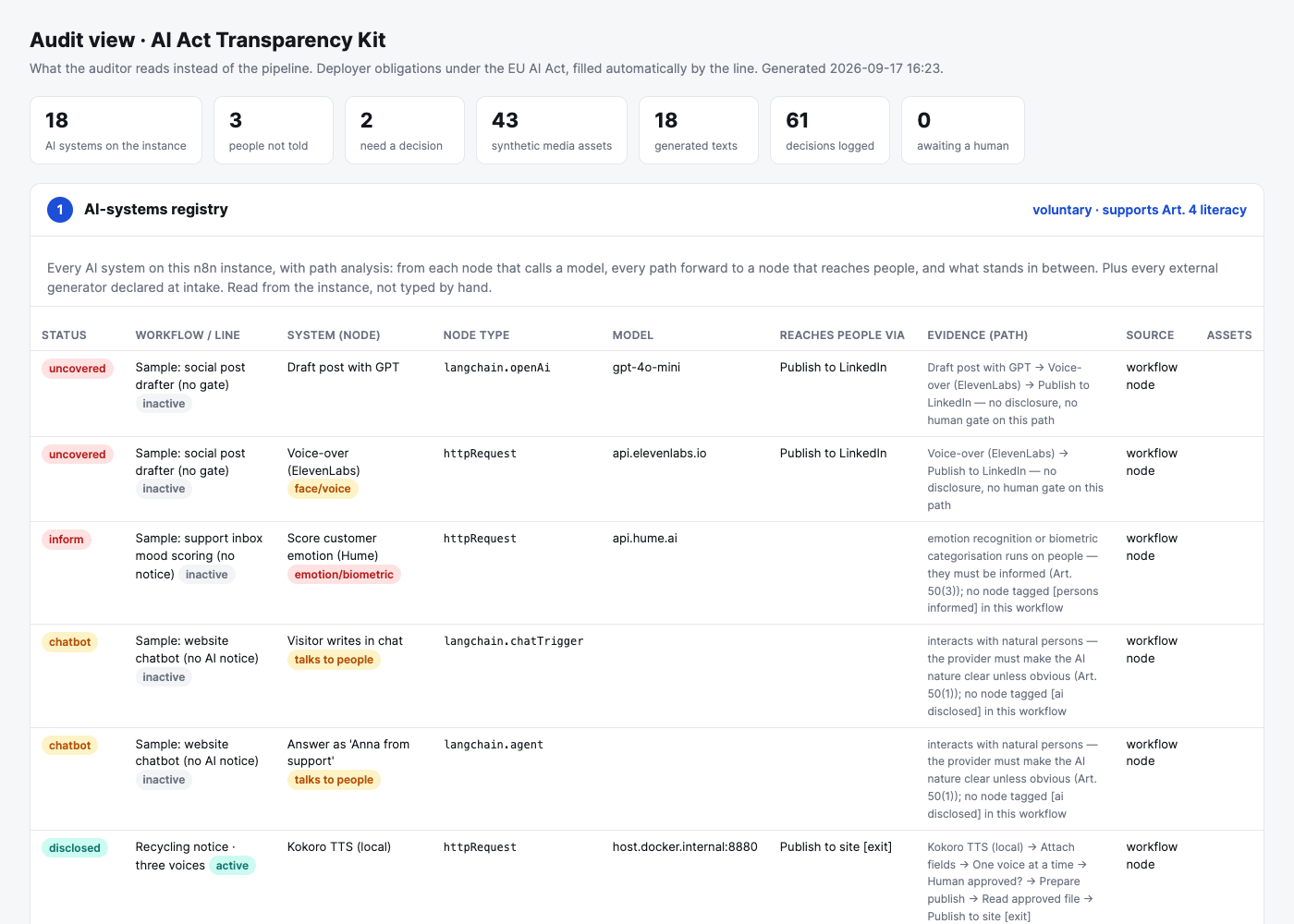
Every AI system on the instance, with the path to people.
The kit reads all workflows through the n8n API and walks from every model node forward. What stands between the generator and the exit decides the status:
uncovered inform chatbot disclosed internal editorial
The audit view
What the auditor reads instead of the pipeline.
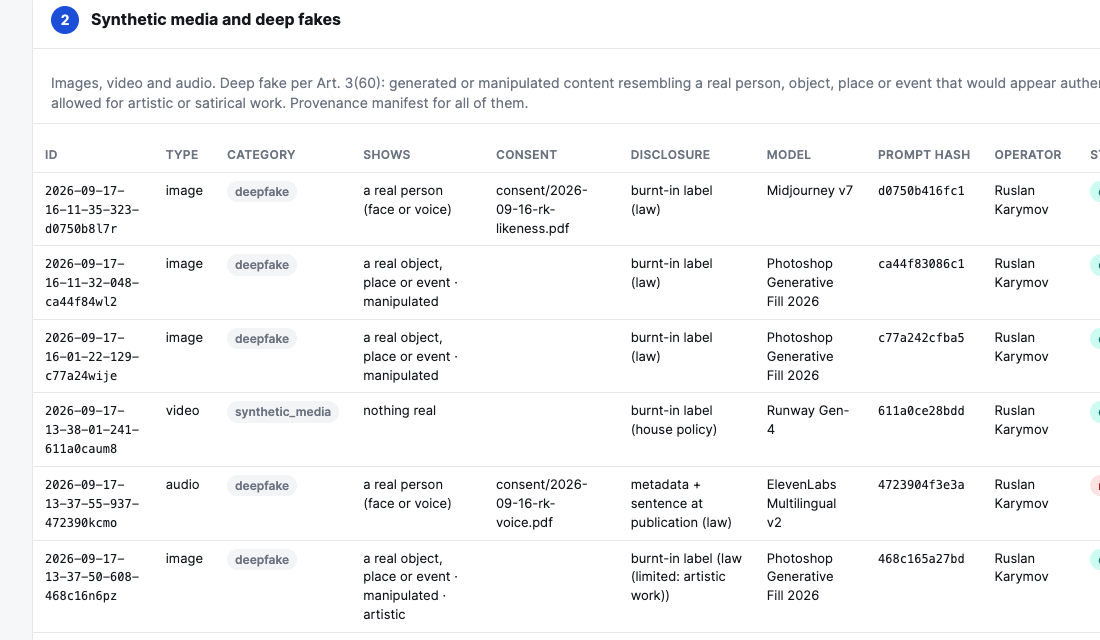
Section 2 of the audit view: every synthetic asset with what it shows, consent reference, disclosure method, model, prompt hash, operator, status, artefact path.
- One GET endpoint, rendered from the ledger. No spreadsheet kept by hand.
- Four sections: registry (Art. 4 literacy, voluntary) · synthetic media (Art. 50(4) §1) · generated text (Art. 50(4) §2) · approval log.
- Legal basis on every block. Voluntary items are labelled voluntary.
Numbers from the ledger
Demo instance, one day, one reviewer.
18
AI systems on the instance
5
paths flagged: 2 uncovered, 2 chatbot, 1 inform
These are demo numbers, not a production benchmark: I answered my own requests within seconds. What the numbers prove is the mechanics: every decision landed, the chain verified after each run, nothing was edited by hand.
Take it
Import the JSON. Point it at your line. Add a Slack channel.
Repository
github.com/karusrus/transparency-kit
Case page and live map
karusrus.github.io/transparency-kit · karusrus.github.io/pipeline-map
What I do in a team's first month: inventory every line that calls a model, put the gate where content reaches people, hand compliance a page they can read without opening n8n.